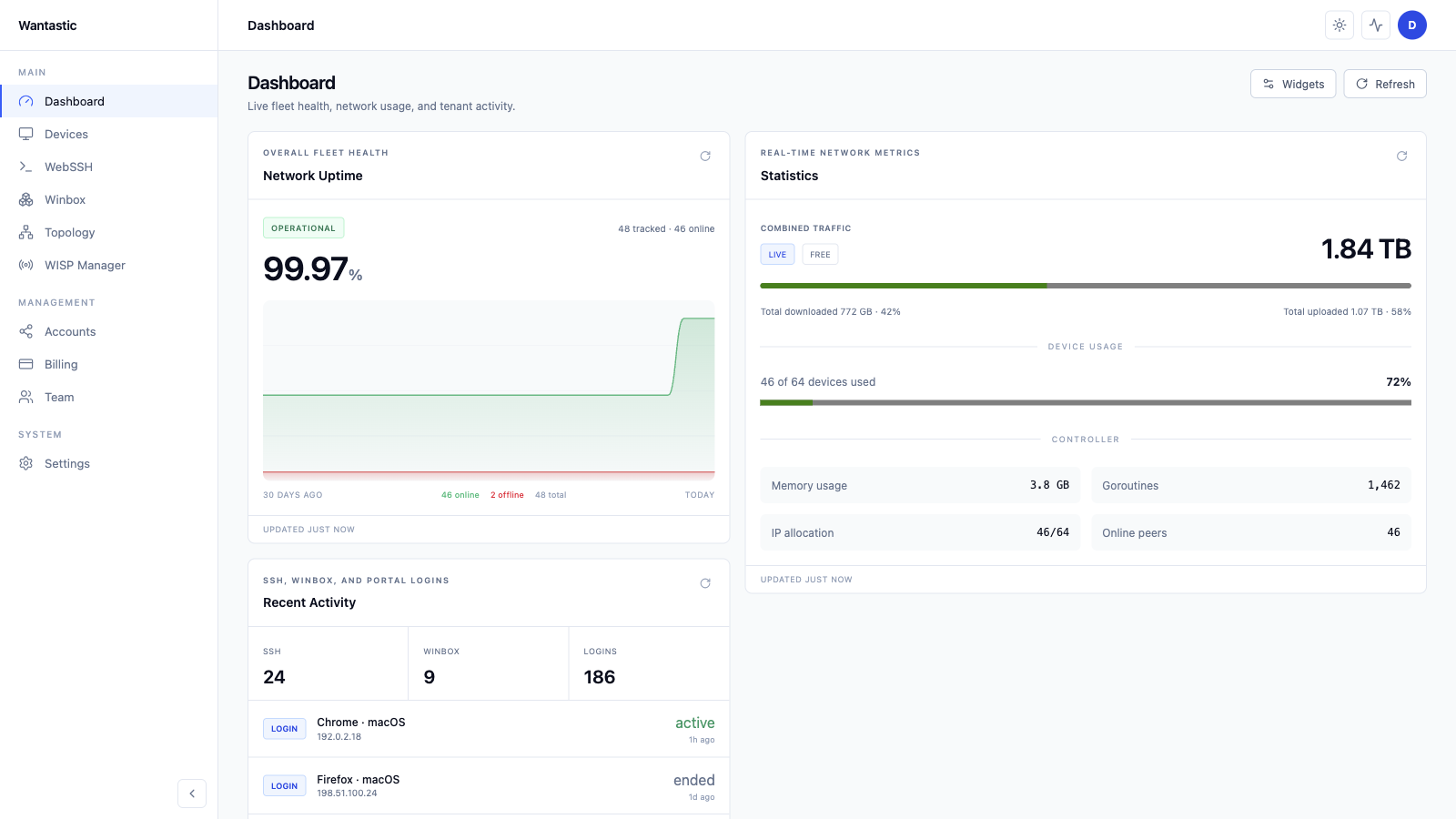
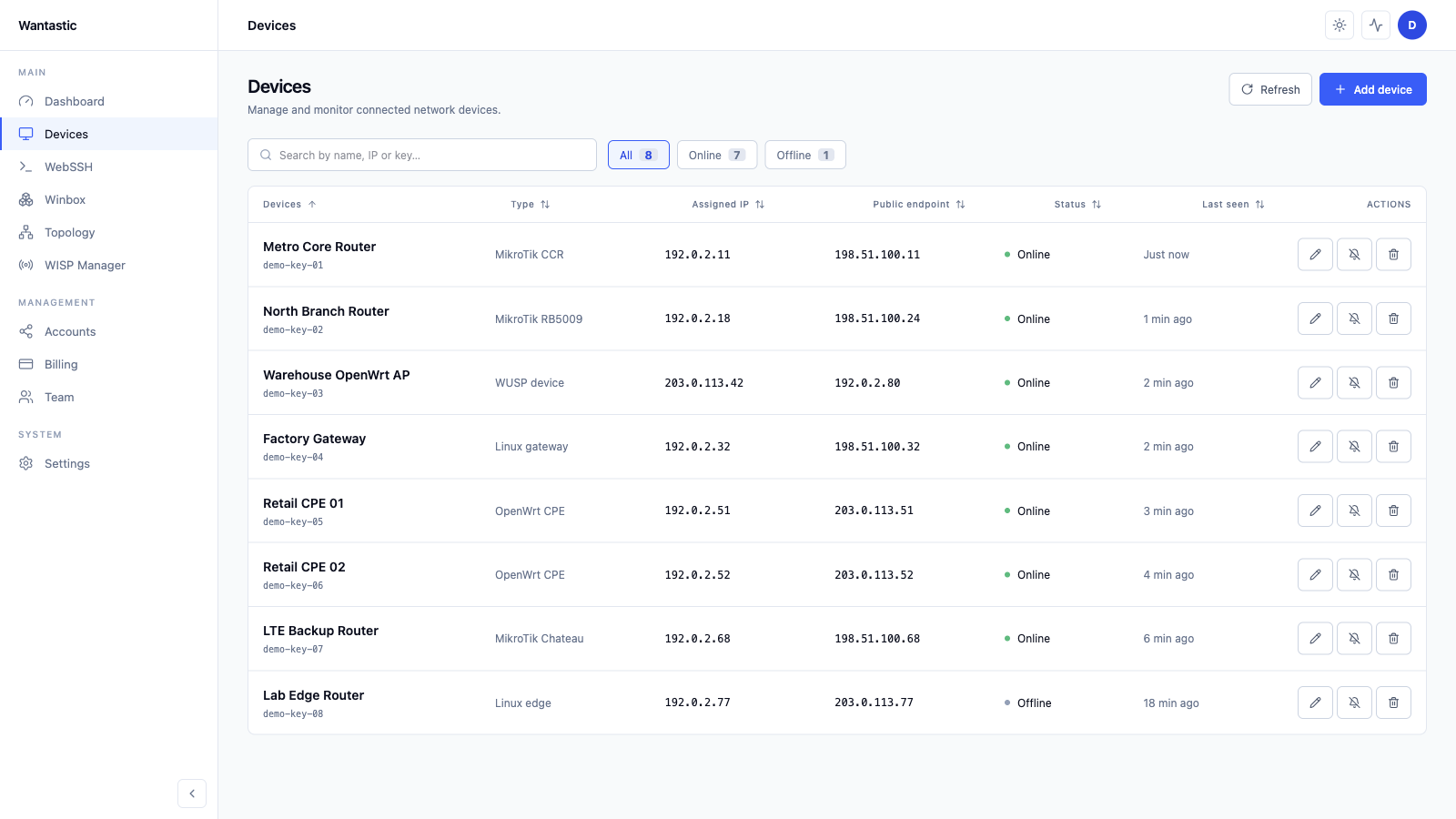
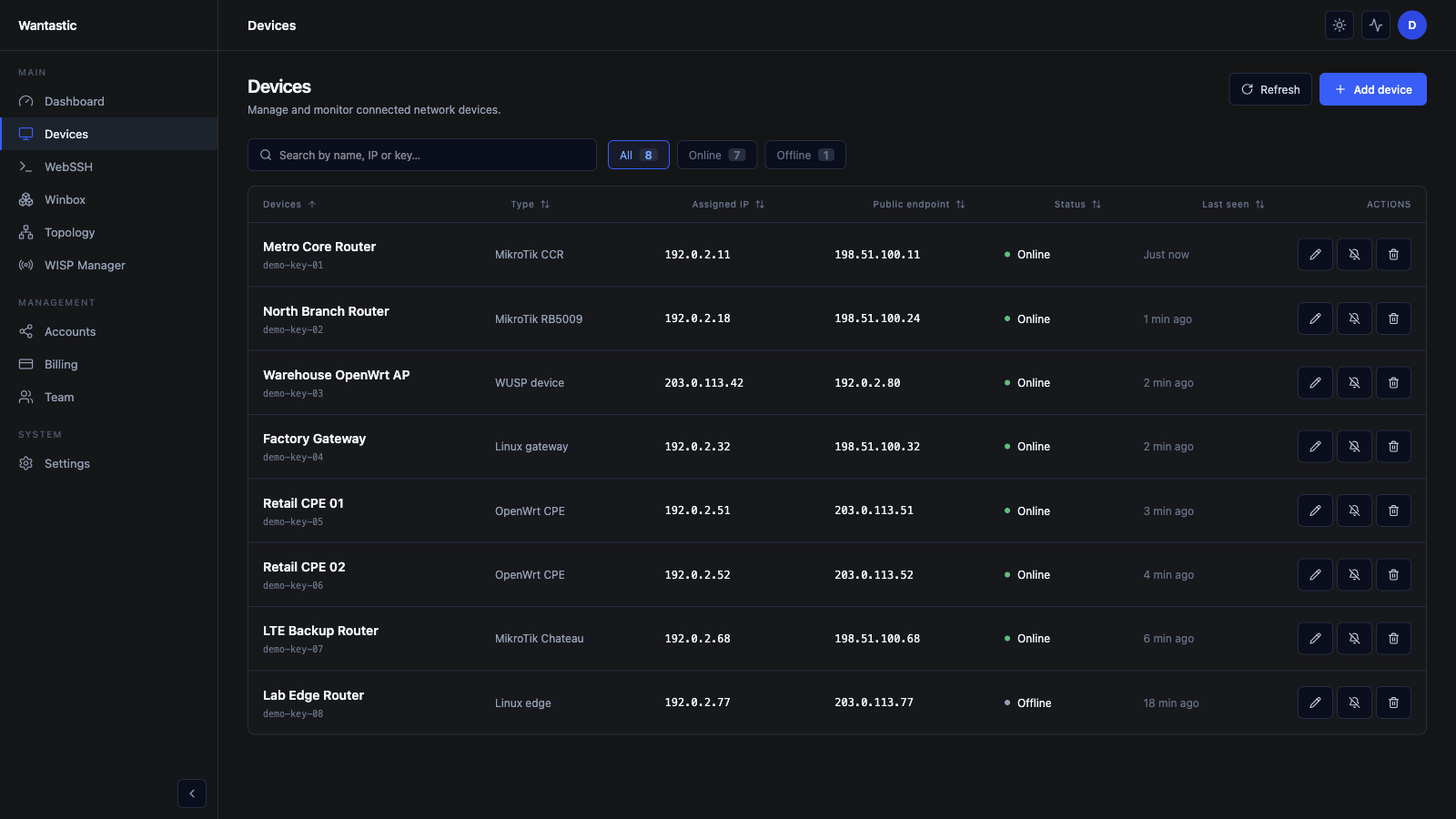
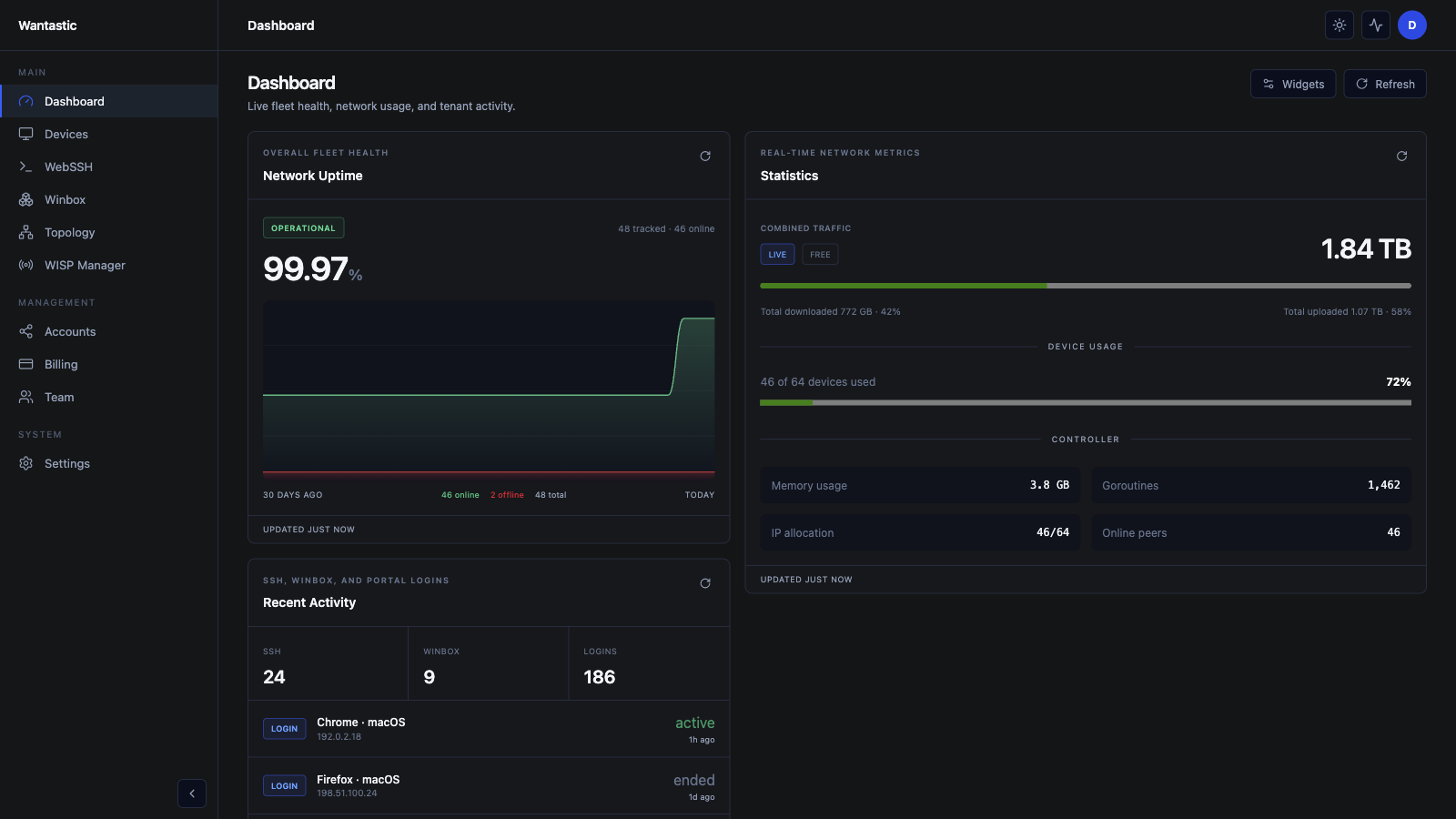
Wantastic is a WireGuard central cloud management dashboard that supports secure WireGuard-based management for MikroTik, OpenWrt, Linux, Android, Windows, and other supported endpoints behind firewalls.
Wantastic USP over WireGuard carries device-management operations inside the existing encrypted tunnel—without exposing another management socket or building a second trust layer.
WUSP is a purpose-built private transport for USP semantics in Wantastic. It is not a drop-in standard Broadband Forum USP Message Transfer Protocol.
Open-source edge client
One agent. Every edge. wantasticd.
A lightweight WireGuard mesh daemon for servers, desktops, OpenWrt routers and embedded IoT devices—with WUSP management and a factory-ready QR claim workflow.
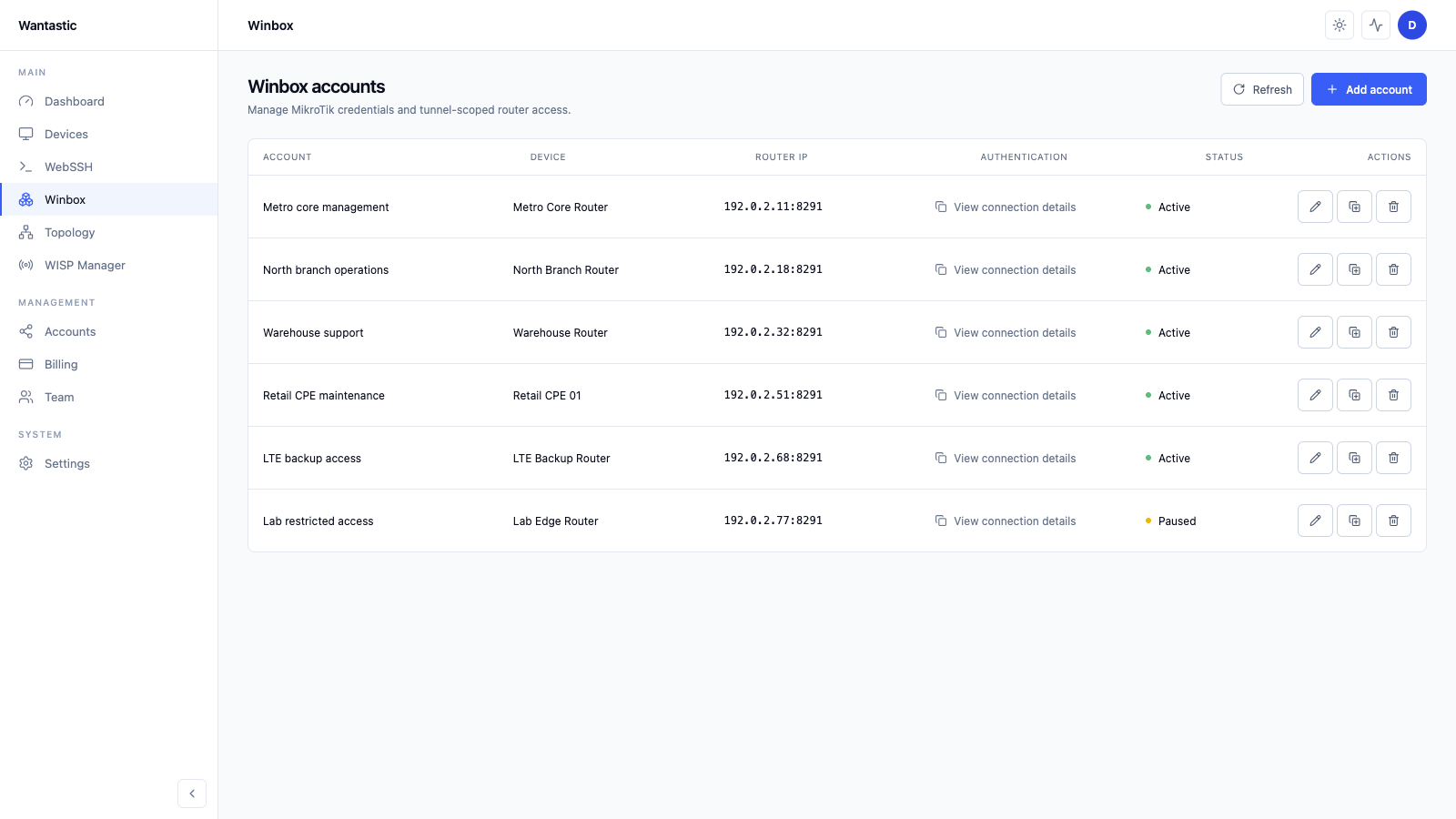
Wantastic helps network operators manage MikroTik RouterOS devices that sit behind CGNAT, LTE, Starlink, customer firewalls, or dynamic residential ISP links. Instead of exposing Winbox port 8291 or maintaining a separate VPN server for every site, Wantastic gives teams managed remote Winbox access for MikroTik/RouterOS devices and uses secure WireGuard overlays for Linux, Windows, Android, OpenWrt, and other supported endpoints.
Remote Winbox Access Without Port Forwarding
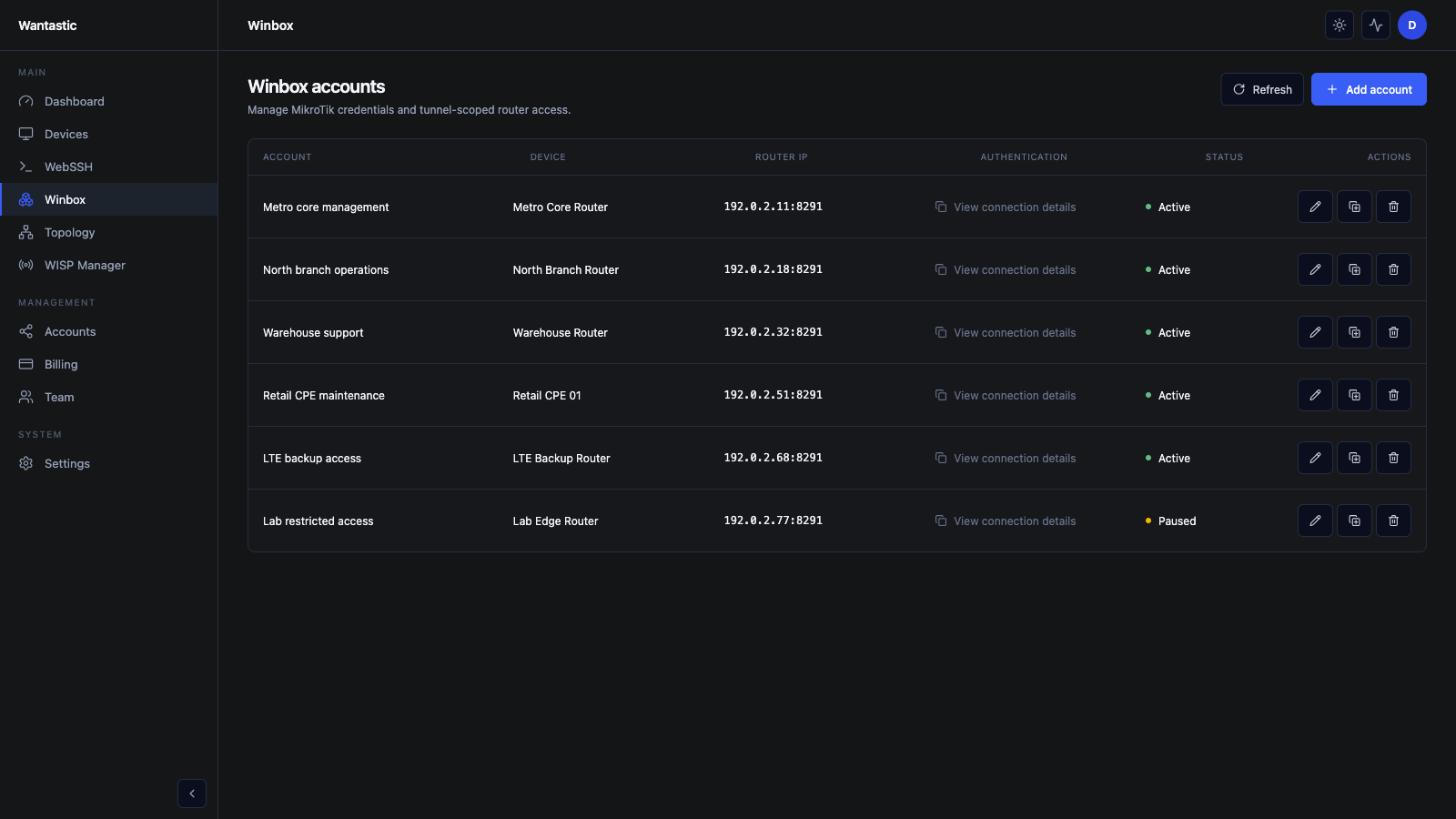
Remote Winbox access should not require a public IP address, inbound firewall rules, shared admin passwords, or a jump server. Wantastic creates controlled Winbox endpoints for MikroTik routers, supports team access, and keeps operations auditable from the cloud management console.
OpenWrt, Linux, Windows, Android and Embedded Device Overlay
The open-source wantasticd agent connects OpenWrt, Linux, Raspberry Pi, containers, Android, macOS and Windows systems to the same management mesh. It is designed for heterogeneous fleets where routers, servers, customer-premises equipment, and embedded devices need secure remote access from one operational workflow.
Open-Source WireGuard Mesh and Self-Hosted Portal
WantasticCore is the open-source self-hosted WireGuard mesh and browser admin portal for teams that need to own the control plane. It combines device onboarding, browser management tools, team access, WebSSH, WebProxy, and policy controls in one deployable platform.
WUSP and Cloud-Native Device Control
Wantastic is moving beyond basic VPN connectivity toward cloud-native device management. WUSP-style workflows, TR-069 and TR-369 device-management ideas, monitoring, browser sessions, topology policy, and managed credentials help operators control devices instead of only tunneling to them.
MikroTik remote management behind CGNAT
Remote Winbox access without exposing port 8291
OpenWrt, Linux, Windows and Android remote access with wantasticd
Self-hosted WireGuard mesh with WantasticCore
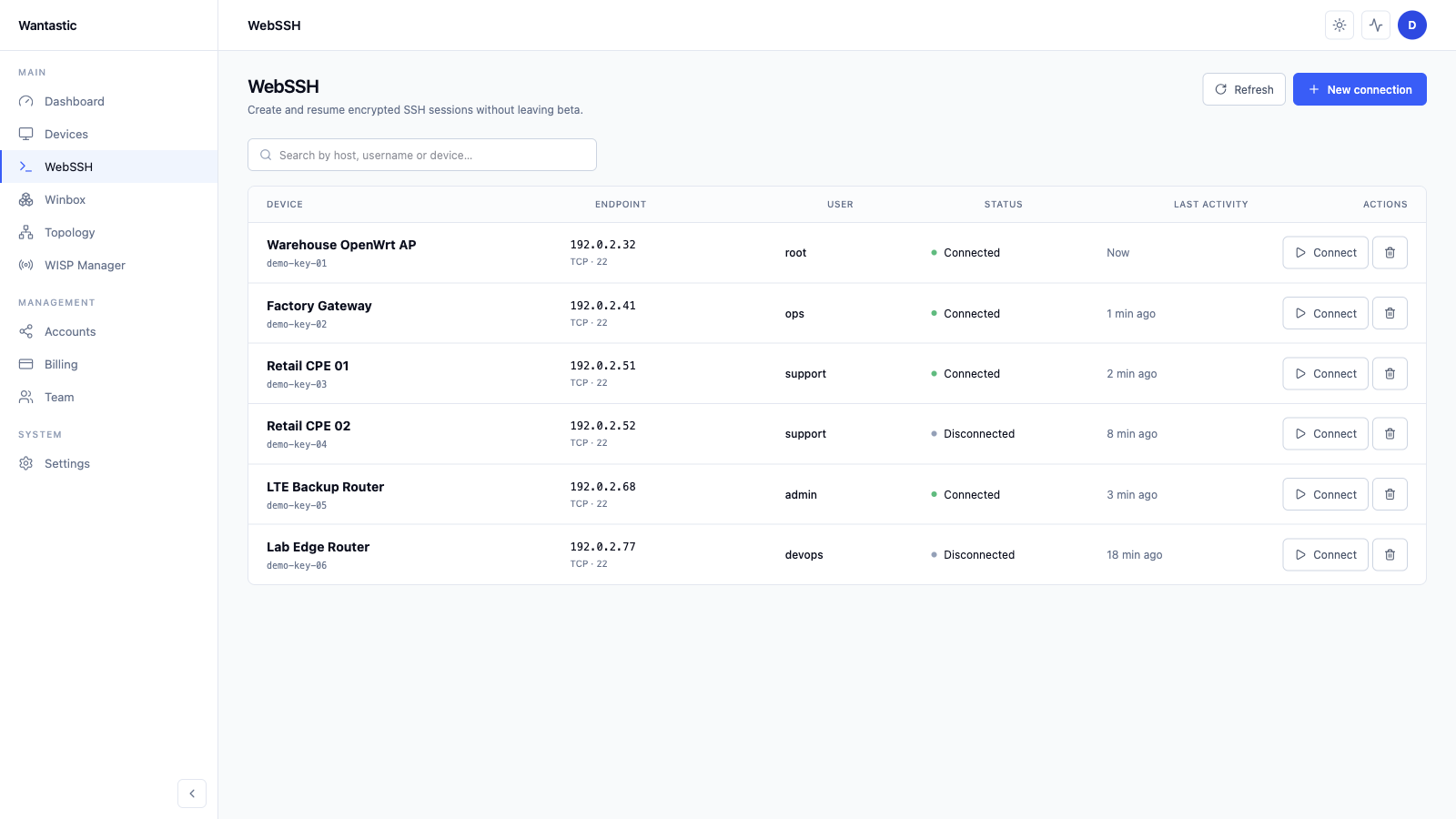
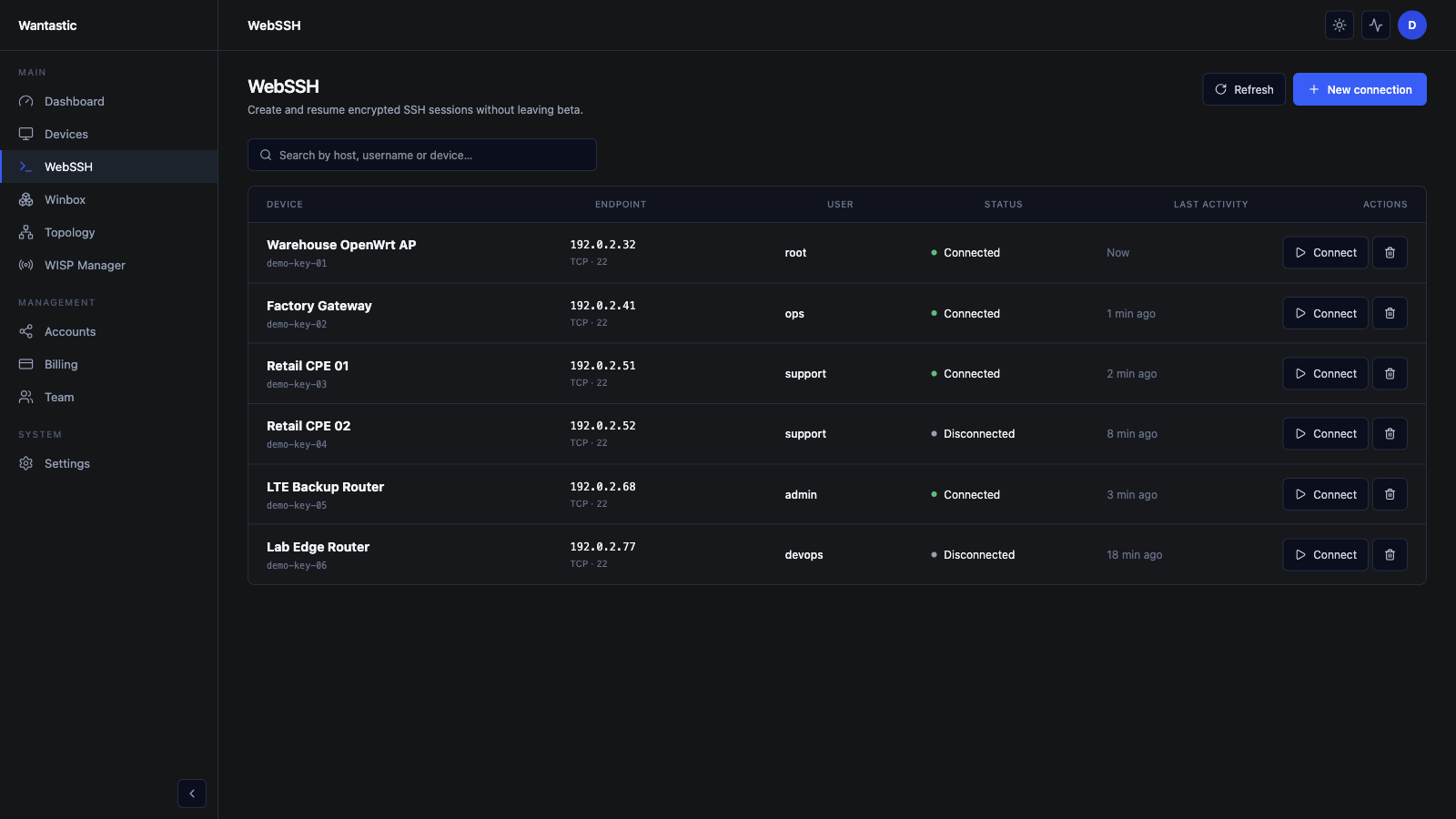
WebSSH and WebProxy for private device interfaces
Team access without shared router credentials
WUSP cloud-native device management
RouterOS 7 native WireGuard onboarding
The Dude alternative for remote access and monitoring
Secure network operations for ISPs, WISPs, MSPs and labs
One operating layer
The problems network teams keep duct-taping are now one workflow.
Remote Winbox, WebSSH, WebProxy, monitoring, team access and policy live in one management layer for MikroTik, OpenWrt, Linux, Windows and Android fleets behind CGNAT, LTE, Starlink or locked-down firewalls.
01RouterOS 7 native WireGuard
Native RouterOS onboarding, no router package
MikroTik devices join with the WireGuard client already built into RouterOS 7, so field installs stay simple and reversible.
Paste the generated RouterOS script, let the router initiate outbound connectivity, and avoid custom binaries on MikroTik hardware.
Reach MikroTik routers through managed overlay endpoints instead of exposing Winbox to scanners or depending on brittle jump boxes.
Give each technician their own controlled session, rotate managed credentials, audit access, and keep native RoMON workflows available for downstream devices.
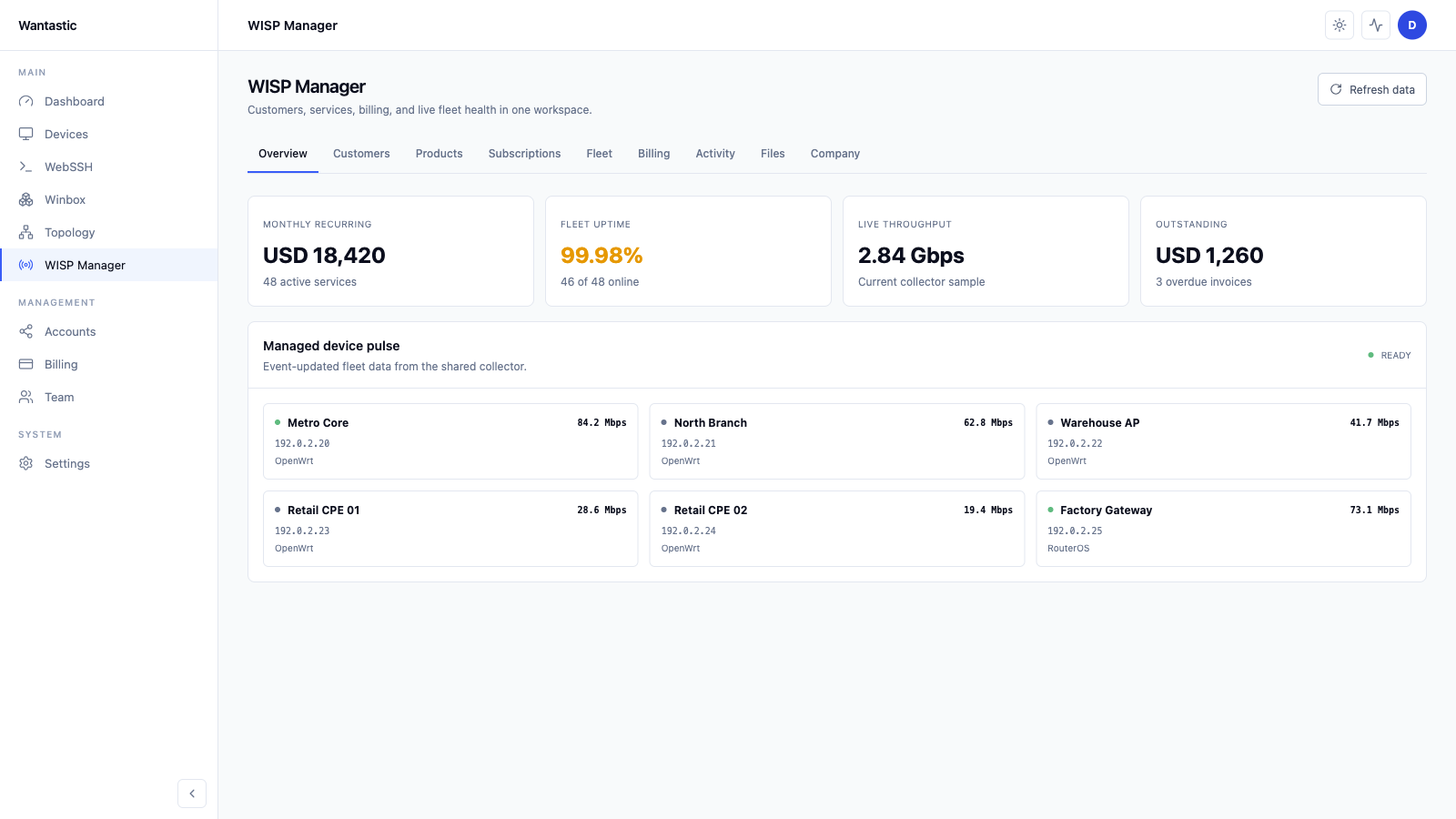
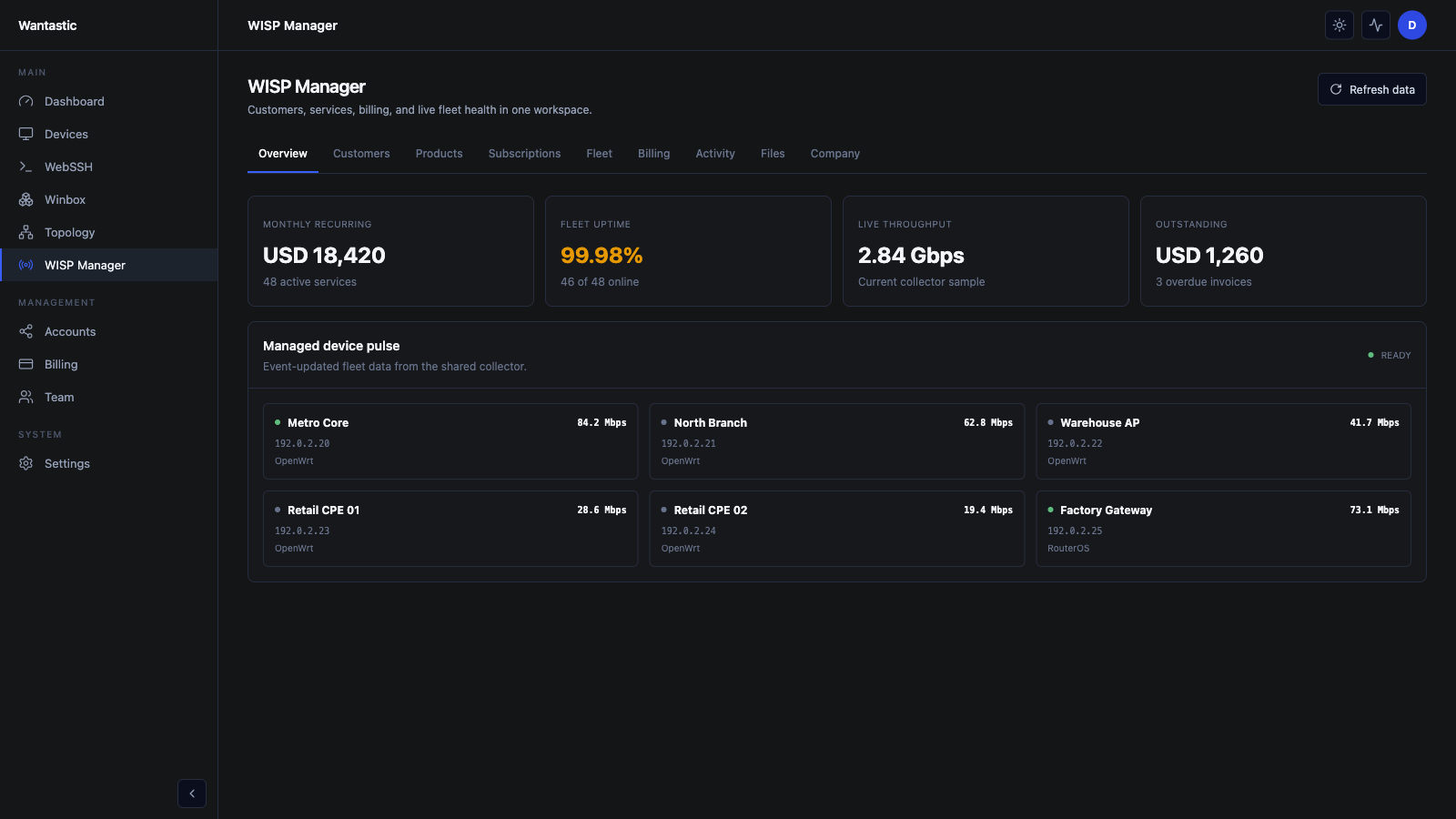
WISP Manager · 48 active services across the demo fleet
From endpoint to console
From unreachable device to managed endpoint.
Wantastic is built around the real support path: connect the device, isolate it, grant access, then work from the browser.
01
Connect without inbound firewall holes
Outbound-first onboarding
Connect RouterOS with native WireGuard, or install wantasticd on OpenWrt and Linux. The device initiates the connection, so CGNAT and dynamic ISP links stop being blockers.
No public Winbox port
RouterOS native WireGuard
wantasticd for Linux and OpenWrt
Works behind NAT and CGNAT
02
Place every device in a private management mesh
Policy-aware routing
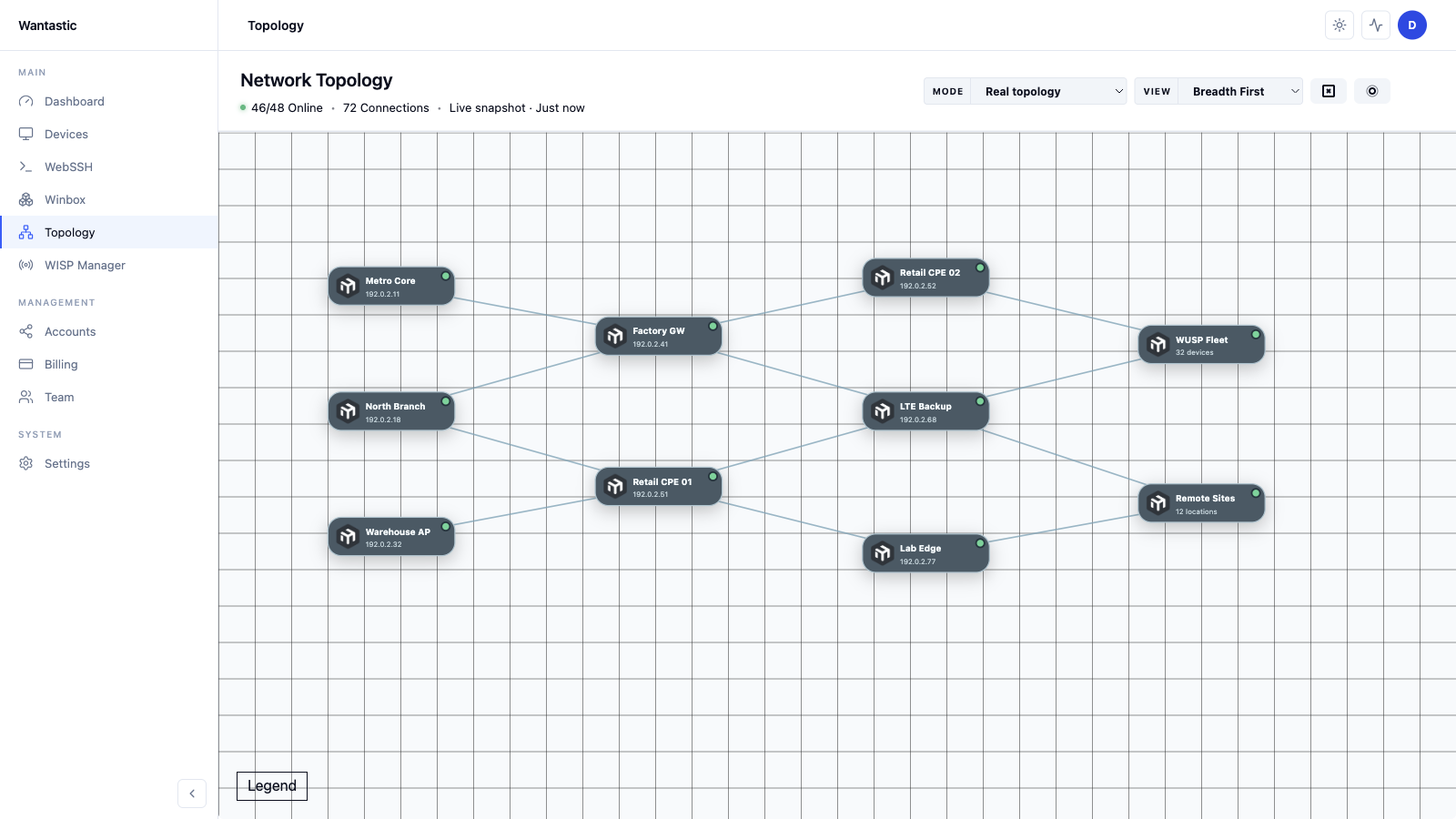
Devices join an isolated overlay where access is intentional. Technicians reach the device workflows they need without joining a flat private network.
Per-tenant virtual routing
Automatic overlay addressing
P2P when possible
Relay fallback when required
03
Control sessions, credentials and device-to-device paths
Least-privilege operations
Model groups, links and protocol-level rules from the portal. Give people access to Winbox, SSH or web interfaces without giving them permanent network keys.
Granular access policies
Managed Winbox credentials
Team invites and revocation
Protocol-level controls
04
Work inside the browser, not inside a VPN client
Winbox, WebSSH, WebProxy, WUSP
Launch Winbox access, persistent WebSSH, LAN-only web interfaces, monitoring and WUSP-style device control from the same console.
Remote Winbox workflows
Persistent WebSSH sessions
WebProxy for private UIs
Uptime and reachability views
What users are saying
Loved by network engineers worldwide
Field notes from operators solving remote Winbox, CGNAT, OpenWrt and browser-based support workflows.
“The real win is not having to expose Winbox or maintain a separate VPN path for every customer site. Devices behind CGNAT are reachable from the console, and the support workflow is much cleaner.”
“Remote Winbox over the overlay solved the annoying Starlink and NAT problem for MikroTik support. I can keep native Winbox and RoMON habits without opening ports at the customer edge.”
“wantasticd makes the Linux and OpenWrt side feel like part of the same management plane. That matters when a site has routers, small servers, and embedded devices on unreliable LTE links.”
“The team access model is the feature I care about most. I can stop handing out shared router credentials and give technicians the exact workflows they need for a device.”
“I used to maintain a WireGuard jump server just to reach routers. Wantastic gives me the tunnel, the browser tools, and the device list in one place, which is the part generic VPN tools miss.”
“The P2P-first design is the right architecture for interactive work. When a direct path is possible, Winbox and SSH feel much better than a relay-only remote access stack.”
“The free plan was enough to test the real workflow: add a router, connect through Winbox, try WebSSH, and see whether it fits support operations before rolling it wider.”
“The open-source direction changed how I looked at the product. WantasticCore and wantasticd make it possible to inspect the architecture instead of trusting a black-box remote access service.”
“The real win is not having to expose Winbox or maintain a separate VPN path for every customer site. Devices behind CGNAT are reachable from the console, and the support workflow is much cleaner.”
“Remote Winbox over the overlay solved the annoying Starlink and NAT problem for MikroTik support. I can keep native Winbox and RoMON habits without opening ports at the customer edge.”
“wantasticd makes the Linux and OpenWrt side feel like part of the same management plane. That matters when a site has routers, small servers, and embedded devices on unreliable LTE links.”
“The team access model is the feature I care about most. I can stop handing out shared router credentials and give technicians the exact workflows they need for a device.”
“I used to maintain a WireGuard jump server just to reach routers. Wantastic gives me the tunnel, the browser tools, and the device list in one place, which is the part generic VPN tools miss.”
“The P2P-first design is the right architecture for interactive work. When a direct path is possible, Winbox and SSH feel much better than a relay-only remote access stack.”
“The free plan was enough to test the real workflow: add a router, connect through Winbox, try WebSSH, and see whether it fits support operations before rolling it wider.”
“The open-source direction changed how I looked at the product. WantasticCore and wantasticd make it possible to inspect the architecture instead of trusting a black-box remote access service.”
Aug 2024
Frequently Asked Questions
Common Questions
Practical answers about remote Winbox, CGNAT, OpenWrt, Linux, Windows, Android, WebSSH and self-hosted WantasticCore.
Stop building one-off access paths for every site.
Start with hosted Wantastic for speed, or explore the open-source WantasticCore when you need a self-hosted WireGuard mesh and browser management portal.