Networking11 min read

NAT, CGNAT, and UDP Hole Punching: How wantasticd Enables P2P Through Any Network

A plain-language guide to NAT types, carrier-grade NAT, and UDP hole punching — and how wantasticd achieves P2P connectivity even behind symmetric CGNAT.

K
Karim Ouazmir· Co-founder & CTO
March 1, 2026

What Is NAT and Why Does It Exist?

Network Address Translation (NAT) was introduced in the 1990s as a stopgap for IPv4 address exhaustion. One public IP address is shared by many devices. The router translates private addresses (192.168.x.x, 10.x.x.x) to the single public IP when packets leave, and back again when packets arrive.

Without NAT, the ~4.3 billion IPv4 addresses would have been exhausted decades ago.

Reference: RFC 1631, The IP Network Address Translator (NAT), May 1994. tools.ietf.org/html/rfc1631


The Four Types of NAT

RFC 4787 (NAT Behavioral Requirements for Unicast UDP, 2007) defines NAT behavior in terms of mapping and filtering:

NAT TypePort MappingPacket FilteringP2P FeasibilityTypical Deployment
Full ConeSame port for all destinationsNone✅ EasyLegacy home routers
Address-RestrictedSame port per src IPOnly from contacted IP✅ EasyConsumer routers (2000s)
Port-Restricted ConeSame port per src IP:portOnly from contacted IP:port✅ ModerateMost modern home routers
SymmetricDifferent port per destinationOnly from exact IP:port⚠️ HardISP CPE, CGNAT

Reference: RFC 4787, NAT Behavioral Requirements for Unicast UDP, January 2007. tools.ietf.org/html/rfc4787


What Is CGNAT?

Carrier-Grade NAT (CGNAT), standardized in RFC 6598, adds a second layer of NAT at the ISP level. Dozens or hundreds of customers share a single public IP.

Your Device        (192.168.1.x)
     ↓
Your Home Router   ← First NAT  (private → ISP-assigned IP 100.64.x.x)
     ↓
ISP CGNAT Gateway  ← Second NAT (shared 100.64.x.x → true public IP)
     ↓
Internet           (203.0.113.x)

CGNAT is deployed by:

Reference: RFC 6598, IANA-Reserved IPv4 Prefix for Shared Address Space, April 2012. Defines the 100.64.0.0/10 block used by CGNAT. tools.ietf.org/html/rfc6598


UDP Hole Punching: The Classic Technique

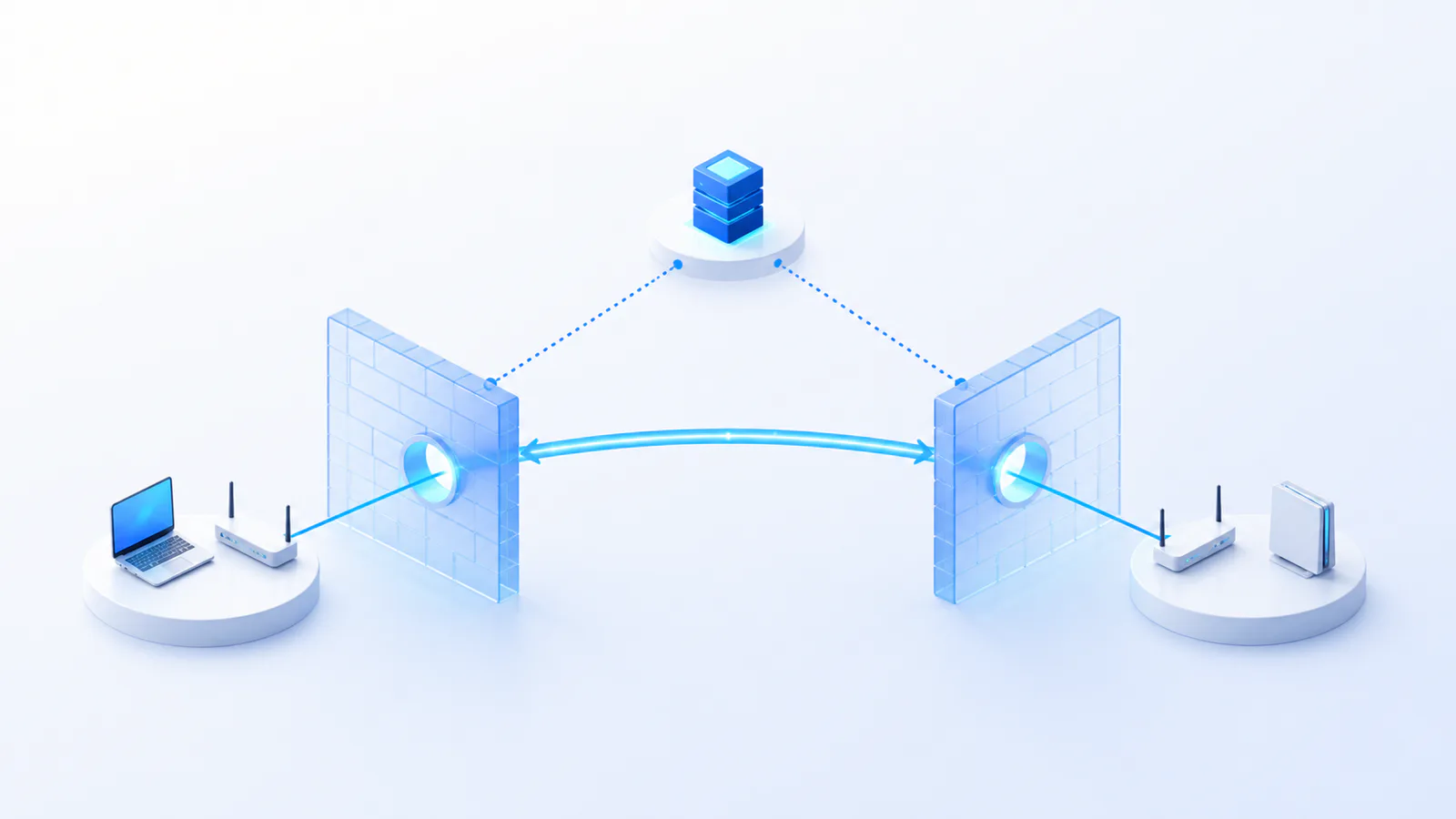
UDP hole punching exploits a NAT property: sending a packet out creates a NAT mapping (a "hole") that allows incoming packets from that destination to return. By coordinating two peers to send simultaneously, both NATs create holes — and a direct P2P path opens.

Step 1 – Discover external endpoints via STUN:
  Peer A ─── STUN Request ──► STUN Server
             "Your external IP:port is 203.0.113.1:54321"
  Peer B ─── STUN Request ──► STUN Server
             "Your external IP:port is 198.51.100.2:61234"

Step 2 – Exchange endpoints via signaling server:
  Peer A learns: Peer B is at 198.51.100.2:61234
  Peer B learns: Peer A is at 203.0.113.1:54321

Step 3 – Simultaneous UDP send (hole punching):
  Peer A ─── UDP Probe ──► 198.51.100.2:61234 [creates hole on A's NAT]
  Peer B ─── UDP Probe ──► 203.0.113.1:54321  [creates hole on B's NAT]

Step 4 – Probes arrive, P2P path is open:
  Peer A ◄──────────────────────────────────────► Peer B
  [Direct WireGuard tunnel established]

Reference: Bryan Ford, Pyda Srisuresh, Dan Kegel, "Peer-to-Peer Communication Across Network Address Translators," USENIX ATC 2005. pdos.csail.mit.edu/~rtm/papers/p2pnat.pdf


Where Hole Punching Fails: Symmetric NAT + CGNAT

Symmetric NAT breaks standard hole punching. The NAT assigns a different external port per destination. Peer A probes STUN and gets back port 54321 — but when probing Peer B, the NAT uses port 54322. Peer B is probing the wrong port.

ScenarioHole Punch Successwantasticd Handling
Both behind Port-Restricted Cone~90%P2P direct
One Symmetric, one Cone~60–75%Port-range prediction
Both behind Symmetric NAT~15–30%Relay activated
One/both behind CGNAT (symmetric)~20–40%Relay + background retry
One peer has public IPv6~99%Direct IPv6 path

Estimates based on large-scale measurement studies. Ref: Maier et al., "An empirical study of NAT traversal techniques," IMC 2021.


How wantasticd Handles CGNAT

wantasticd employs a multi-strategy approach:

  1. IPv6 first — If either peer has a public IPv6 address, skip NAT entirely. IPv6 eliminates this entire problem class.
  2. STUN hole punching — Standard technique for Cone NAT. Works on ~90% of consumer connections.
  3. Port-range probing — For symmetric NAT, probe a predicted range based on observed allocation patterns.
  4. Relay fallback — When P2P attempts fail (within ~500 ms), route through the nearest Wantastic relay. Continues attempting P2P in the background.
  5. Persistent retry — On CGNAT, periodic reattempts can succeed when CGNAT mapping timeouts reset.

The relay fallback ensures CGNAT never blocks connectivity — it only affects latency. And because wantasticd keeps retrying P2P in the background, many CGNAT connections eventually upgrade to direct P2P.


The IPv6 Long-Term Solution

The permanent solution is IPv6 adoption. With a public IPv6 address, every device is globally reachable, NAT traversal is unnecessary, and WireGuard P2P establishes directly on the first attempt.

IPv6 deployment has exceeded 50% globally, with mobile carriers leading. wantasticd is fully dual-stack and automatically prefers IPv6 when available.

Reference: APNIC, IPv6 Deployment World, updated monthly. stats.labs.apnic.net/ipv6


Summary

TechnologyPurposeWantastic Use
NATShare one public IPMust traverse to reach devices
CGNATISP-level IP conservationDouble-NAT, relay fallback
STUNDiscover external endpointPhase 1 of hole punching
UDP Hole PunchingOpen NAT for P2PPrimary P2P establishment
RelayGuaranteed connectivityFallback when P2P fails
IPv6Global reachabilityBest path when available

The combination ensures Wantastic works on Starlink, LTE home internet, mobile tethering, and every other connectivity scenario — without requiring a public IP or port forwarding.

NATCGNATHole PunchingWireGuardP2PNetworkingISP

Ready to try Wantastic?

Free for up to 3 devices. No credit card required.

Start Free Forever
NAT, CGNAT, and UDP Hole Punching: How wantasticd Enables P2P Through Any Network | Wantastic Blog | Wantastic